The Quantum Time Bomb: Understanding the “Harvest Now, Decrypt Later” Cyber Threat
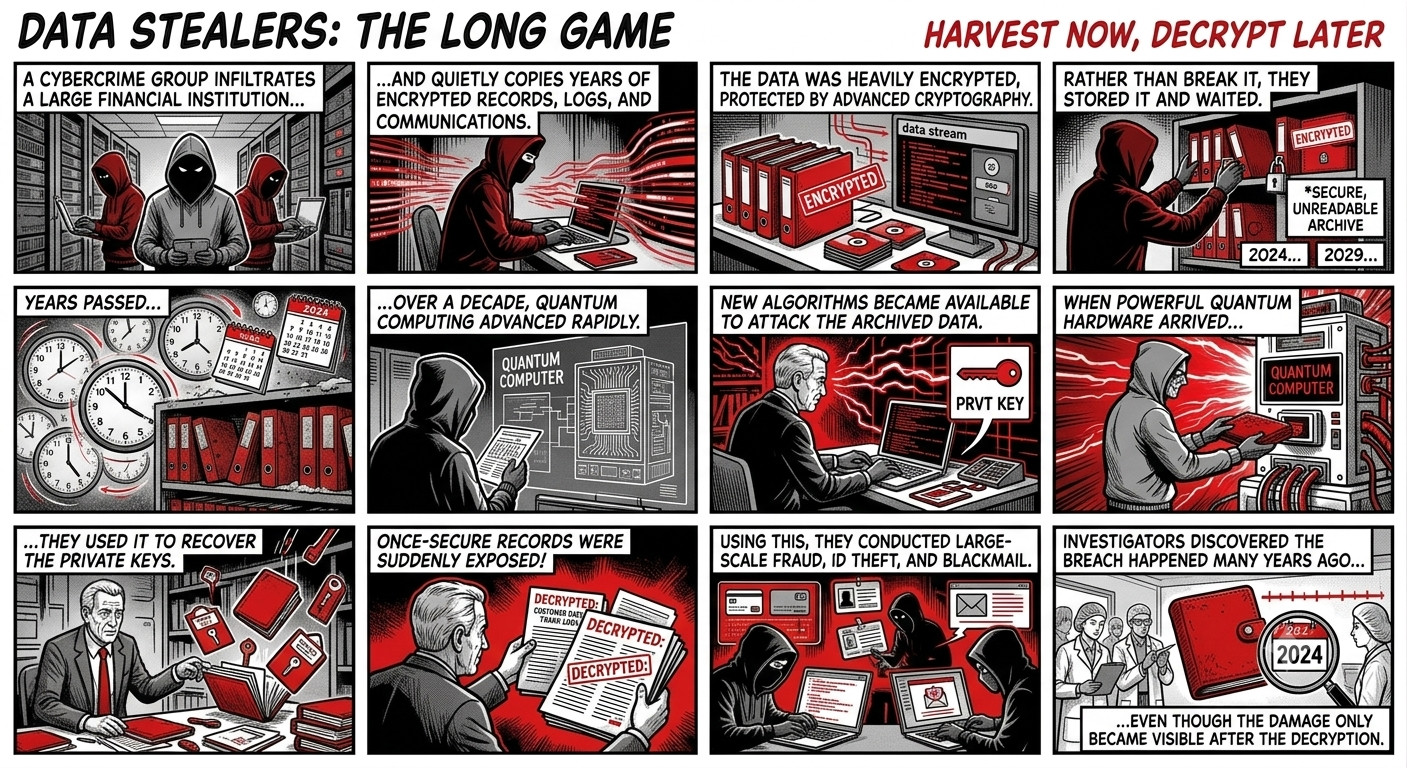
Imagine a sophisticated adversary breaking into a secure facility, ignoring the immediate assets, and walking out with a heavily reinforced, indestructible steel safe. They cannot open it today. They do not possess the combination, the physical tools, or the technology to even scratch its surface.
So, what can they do? They can wait. They can transport the stolen safe to a secure, climate-controlled basement and wait. With this, they are betting on the certainty that future technology will eventually make cracking that safe effortless.
In the digital landscape, this strategy is not a hypothetical scenario—it is an active, ongoing operation known as the “Harvest Now, Decrypt Later” (HNDL) threat. Also referred to as retrospective decryption, HNDL represents a paradigm shift in cyber espionage, where current data interception is fueled by the promise of future computational breakthroughs.
What is the HNDL Threat?
At its core, “Harvest Now, Decrypt Later” is a cybersecurity threat where malicious actors — primarily well-funded nation-state adversaries — intercept and store massive volumes of encrypted data today. The data is currently unreadable due to robust, modern encryption standards like RSA or Elliptic Curve Cryptography (ECC).
However, attackers are accumulating this data with the explicit intent of decrypting it once Cryptanalytically Relevant Quantum Computers (CRQCs) become viable.
While classical computers would require billions of years to break modern public-key cryptography, quantum computers operating on the principles of quantum mechanics will be capable of solving these complex mathematical foundations in mere minutes.
How HNDL Operates?
The HNDL threat operates across a multi-stage timeline that bridges contemporary network exploitation with future quantum computation. The lifecycle can be broken down into four distinct phases:
Phase 1. Mass Interception (Harvest Now)
Adversaries deploy sophisticated tap points on backbone internet infrastructure, compromise undersea fiber-optic cables, or breach corporate networks to exfiltrate data. They are not selective; they gather massive quantities of encrypted traffic indiscriminately, targeting government communications, proprietary corporate R&D, intellectual property, financial records, and military intelligence.
Phase 2. Infinite Storage (Hoarding)
Because the cost of digital storage has plummeted drastically over the last decade, maintaining exabytes of encrypted data is economically feasible for nation-states. The stolen data is organized, cataloged, and securely hoarded in massive data repositories, awaiting the necessary decryption tools.
Phase 3. Retrospective Decryption (Decrypt Later)
The catalyst for this threat is the realization of a CRQC. Quantum computers utilize principles of quantum mechanics to run specialized algorithms — most notably Shor’s Algorithm — which mathematically undermines the asymmetric encryption used to protect almost all modern internet communication.
Once a quantum computer achieves the required scale and fault tolerance, the stored datasets will be fed into the system. The encrypted text will then be rapidly converted back into plaintext, exposing historical secrets, communications, and assets to the adversary.
Why HNDL is an Immediate Danger: The Shelf-Life of Secrets
A common misconception is that HNDL is a future problem because quantum computers capable of breaking encryption do not fully exist yet. However, the risk is determined by the shelf-life of your data. If an adversary decrypts a ten-year-old password, it is likely useless. But if they decrypt ten-year-old state secrets or intellectual property, the fallout can be catastrophic.
Data categories with extended shelf-lives include:
- State and Military Secrets: Defense strategies, diplomatic communications, and weapon design schematics remain highly sensitive for 30 to 50 years.
- Biometric and Healthcare Data: Unlike a compromised password, an individual cannot change their DNA profile, fingerprints, or medical history. This data remains valuable for a lifetime.
- Corporate R&D and Intellectual Property: Long-term proprietary formulas, industrial manufacturing processes, and trade secrets dictate a corporation’s competitive edge for decades.
To quantify this risk, cryptographer Michele Mosca formulated Mosca’s Theorem. It states that if the time your data must remain secure (X) plus the time required to migrate your infrastructure to quantum-safe systems (Y) is greater than the time it takes for a practical quantum computer to be built (Z), then you have already lost your data security.
Defending Against the Quantum Threat: Post-Quantum Cryptography
The mathematical threat of quantum computing requires a mathematical defense. The international security community is actively transitioning to Post-Quantum Cryptography (PQC). Organizations like the National Institute of Standards and Technology (NIST) have finalized standardization for primary quantum-resistant algorithms, including ML-KEM (for encryption) and ML-DSA (for digital signatures).
Unlike RSA or ECC, which rely on the difficulty of factoring large integers or computing discrete logarithms, PQC algorithms are built on complex geometric lattice problems. These problems are mathematically secure against both classical and quantum architectures. Implementing PQC today ensures that any data harvested by an adversary now will remain an unbreakable black box, even when evaluated by the quantum computers of tomorrow.
What can we do?
The “Harvest Now, Decrypt Later” threat effectively destroys the concept of retroactive data security. Waiting for quantum computers to fully mature before upgrading encryption protocols guarantees that all data transmitted in the interim is compromised. For modern organizations, the timeline to act is not decades away—it is right now. Migrating to post-quantum standards is the single most critical step in defusing the quantum time bomb.
Q-Fence is here to help with these transitions and to provide solutions combining mathematical defense and enforcing them with quantum random number generators. Not only does Q-Fence help prepare for the quantum future; it also harnesses quantum technologies to ensure security against quantum threats.
Follow Q-FENCE Website: www.qfence-project.eu · LinkedIn: @Q-Fence · Zenodo: Q-FENCE Community · YouTube: @Q-FENCE
This project has received funding from the European Union’s Horizon Europe research and innovation programme under Grant Agreement N° 101225708, as well as the Swiss State Secretariat for Education, Research and Innovation (SERI). Views and opinions expressed are those of the author(s) only and do not necessarily reflect those of the European Union or SERI.