Healthcare
Healthcare
Secure Sharing of Encrypted Health Data

The Challenge
Medical researchers and professionals need access to large datasets that contain sensitive data about the patients and their past and current health problems. However, sharing patient records carries high privacy risks and must comply with strict regulations. To provide treatment, sharing patient records must be fast, secure, and tamper-resistant.
Additionally, long data lifetime for healthcare systems makes them especially vulnerable for the harvest now, decrypt later approach, motivating the proactive utilization of post-quantum methods and ensuring the long-term security of the data.

The Q-FENCE Solution
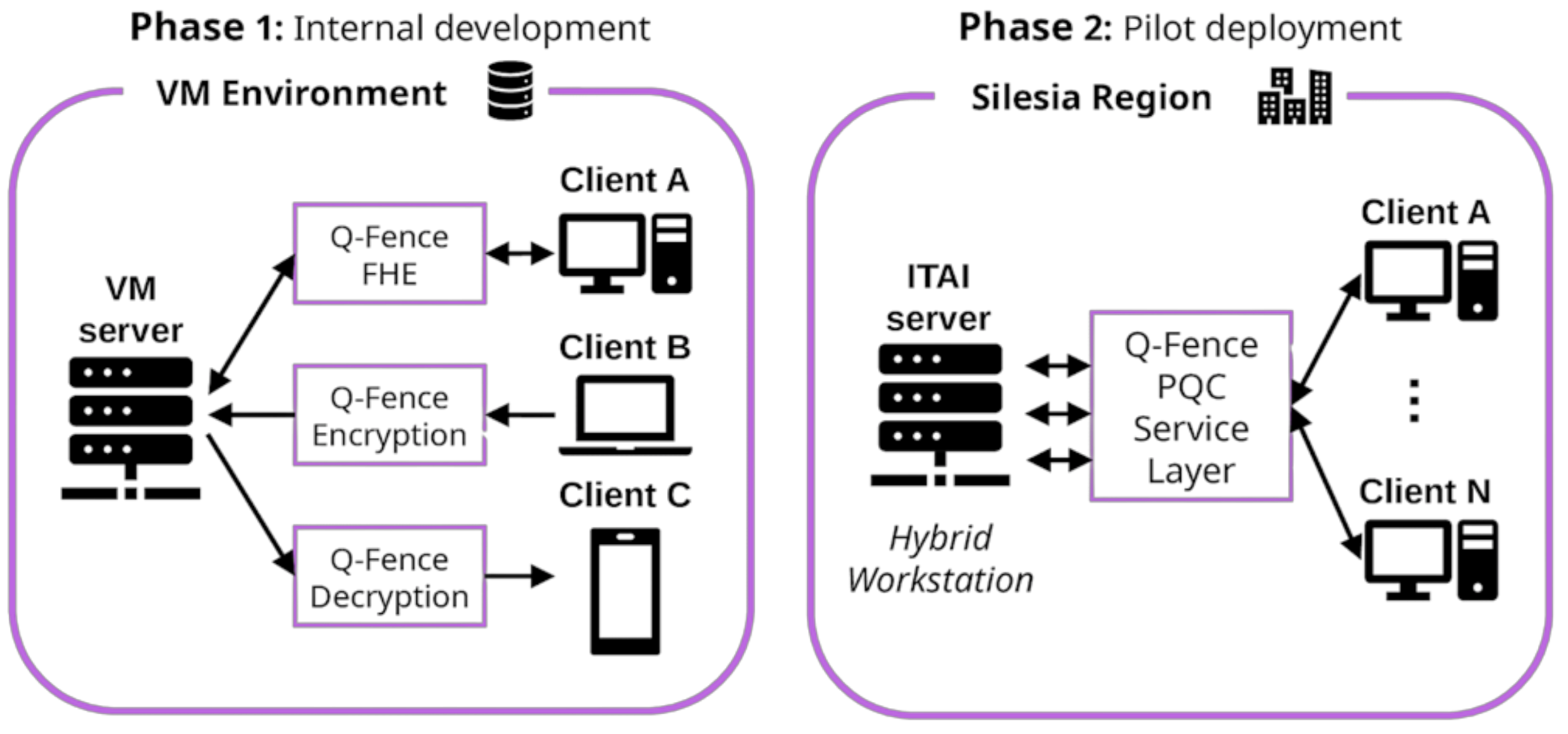
Q-FENCE establishes a secure hybrid base station that combines classical and quantum resources to process encrypted healthcare data.
Additionally, by using Homomorphic Encryption (HE), the Q-FENCE solutions will provide a unique solution to perform computations on patient data without decrypting it and without directly accessing sensitive data.
Hence, the Q-FENCE solution not only integrates the cutting-edge cryptographic solutions, providing the highest level of security, but it also enables the mechanism for ensuring the privacy of data, minimizing the costs related to compliance with regulations regarding data protection.

Location
Silesia region, Poland. The pilot will be developed with selected institutions working with medical data.


Key Features
The pilot connects with European data spaces to use anonymized datasets for research. It creates a system where classical hospital networks can interoperate securely with quantum computing capabilities for advanced data processing. The pilot will focus on delivering the highest possible level of security, privacy, and integrity, at the same time adjusting the solution to the needs of end-users.

The Impact
- Increased patient privacy by securely storing and sharing medical history, including mental health and genetic data.
- Built-in data integrity for preventing the alteration of medical records.
- Secure authentication, ensuring that the right patient receives the appropriate treatment.
- Access control for sharing data between the units of one institution or between different institutions.
- Transparency for gaining the patient’s trust to ensure that the data shared for medical purposes are safe and will not be used for other purposes.
- Lowering the legal costs of medical institutions and medical software provided by ensuring compliance with laws regarding privacy, e.g. General Data Protection Regulation in the EU requires the protection of personal data.