Quantum Leap: Q-FENCE Launches Student Cryptography Webinar Series
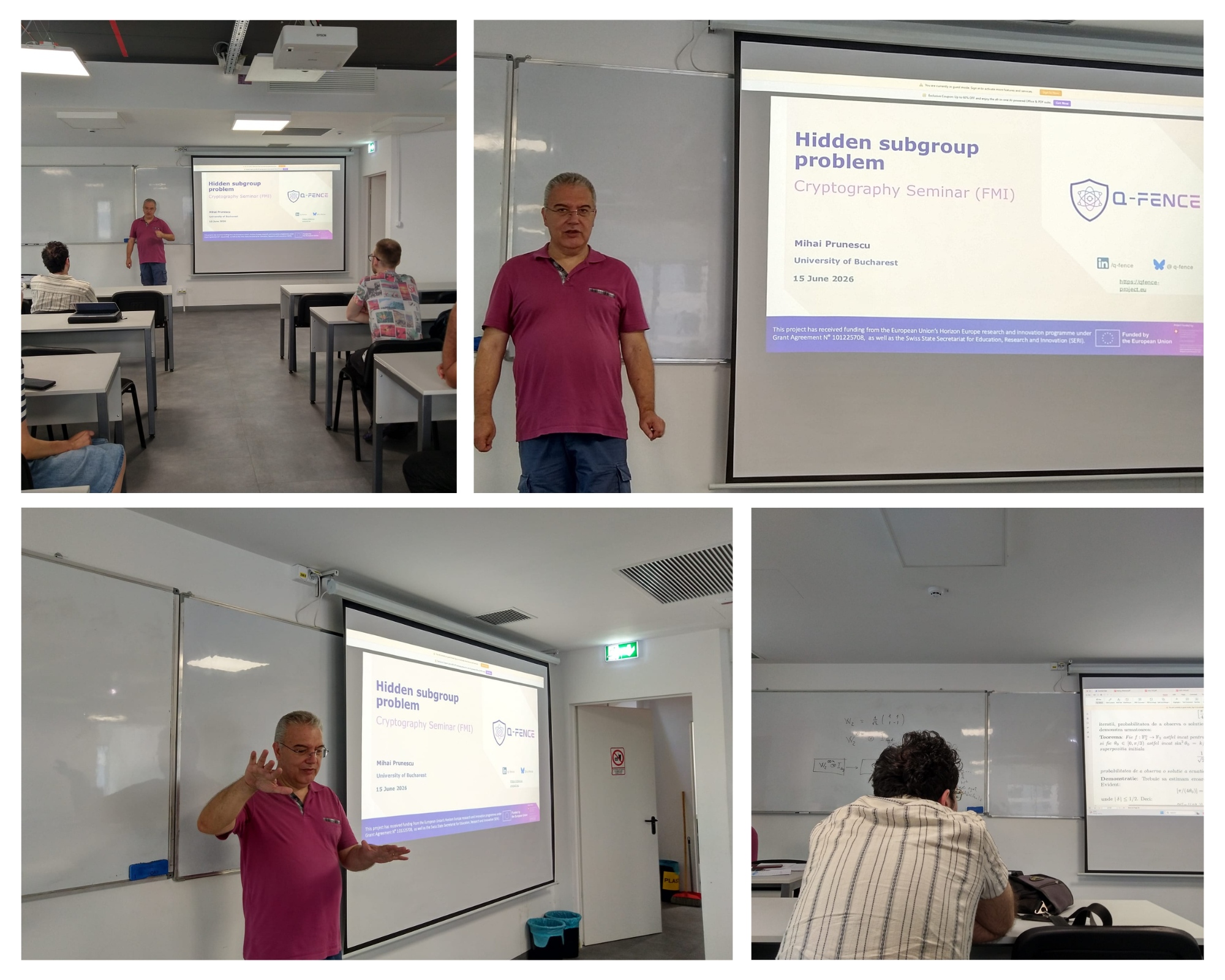
As part of its commitment to engaging and educating students on emerging cybersecurity challenges, the Q-FENCE project successfully organised a series of four webinars dedicated to quantum computing and its implications for modern cryptography. Delivered within the Cryptography Seminar at the Faculty of Mathematics and Computer Science, University of Bucharest, the talks were presented by Associate Professor Mihai Prunescu, a member of the University of Bucharest Q-FENCE team, with the support of the Q-FENCE project.
The webinar series provided students, researchers, and academics with an opportunity to deepen their understanding of quantum computing fundamentals while exploring the growing impact of quantum technologies on cybersecurity and cryptography.
The first webinar, “Quantum Computing“, held on 6 March 2026, introduced participants to the fundamental concepts of quantum computation. The session covered probability distributions, Markov chains, quantum superposition, unitary matrices, Hermitian spaces, qubits, qubit registers, the Hadamard-Welch transform, entanglement, and the No Cloning Theorem. Participants also explored the key differences between classical and quantum computation, highlighting how quantum computers can significantly accelerate computation by exploiting exponentially many simultaneous states.
The second webinar, “Quantum Computing (II)“, held on 27 March 2026, focused on the reversibility of quantum computation. Participants learned why quantum computations are inherently reversible due to the invertibility of unitary matrices and how classical computations can be embedded into reversible computations before being implemented using quantum gates. The session also demonstrated this process through the use of Toffoli gates.
The third webinar, “Quantum Computing (III)“, took place on 3 April 2026 and introduced the Quantum Fourier Transform (QFT), its behaviour in the presence of orbits, and its connection to Shor’s factoring algorithm. The discussion emphasised the impact of quantum computing on widely used cryptographic protocols such as RSA and presented recent advances in quantum attacks against elliptic-curve cryptography. These developments reinforced the urgency of preparing for the transition towards post-quantum security.
The final webinar, “Hidden Subgroup Problem“, held on 15 June 2026, explored quantum circuits designed to solve the Hidden Subgroup Problem, closely related to the Discrete Logarithm Problem. The presentation also introduced Grover’s acceleration and recalled the implications of computational complexity for secure symmetric communication. The session concluded with an engaging discussion in which participants contributed new insights into the underlying theoretical problems.
The webinar series successfully strengthened participants’ understanding of the rapidly evolving quantum landscape and highlighted several key takeaways. Quantum computing fundamentals emerged as essential knowledge for students, researchers, and academics working in cryptography and cybersecurity. The discussions demonstrated that quantum threats directly affect the cryptographic algorithms widely deployed today and illustrated how quantum superposition enables computational speedups that are unattainable in classical computing. Participants also recognised that the rapid progress in quantum technologies and quantum attacks is driving important scientific discussions and further underlines the need to develop secure post-quantum cryptographic solutions.
Through this four-part webinar series, Q-FENCE continued to support its objective of raising awareness, building knowledge, and inspiring the next generation of cybersecurity professionals to address the challenges and opportunities presented by the quantum era.