

“The move to post-quantum cryptography cannot happen with the flick of a switch. Hybrid cryptography offers a practical bridge, protecting today’s systems while introducing algorithms designed for the quantum era”.
Imagine replacing a bridge while traffic is still crossing it. The old structure cannot simply be closed, yet it cannot remain unchanged forever. The challenge is to strengthen it while keeping everything moving.
Cybersecurity faces a similar transition.
For decades, digital systems have relied on public key cryptography, such as RSA and elliptic curve cryptography (ECC), for secure connections, authentication, and digital transactions. These technologies are embedded across banking, cloud services, healthcare and connected devices. Quantum computing, however, challenges the long term security assumptions behind them, while organisations cannot replace decades of infrastructure overnight.
This is where hybrid cryptography becomes important.
Why not simply switch to post-quantum cryptography?
The first major post-quantum standards are already here. In August 2024, NIST finalised ML-KEM for key establishment and ML-DSA and SLH-DSA for digital signatures. But standardising an algorithm and deploying it widely are very different challenges.
Organisations depend on mixtures of legacy hardware, cloud services, mobile applications, embedded devices and third party software. Some components can be upgraded easily; others may remain operational for years.
Post-quantum algorithms can also bring different processing, memory and communication requirements. Migration, therefore, requires testing for interoperability, performance, implementation security and compatibility with existing infrastructure.
Hybrid cryptography gives organisations time to introduce PQC without abandoning systems they still depend on. It is also moving into practical deployment, with guidance and emerging standards for combining classical and post-quantum mechanisms.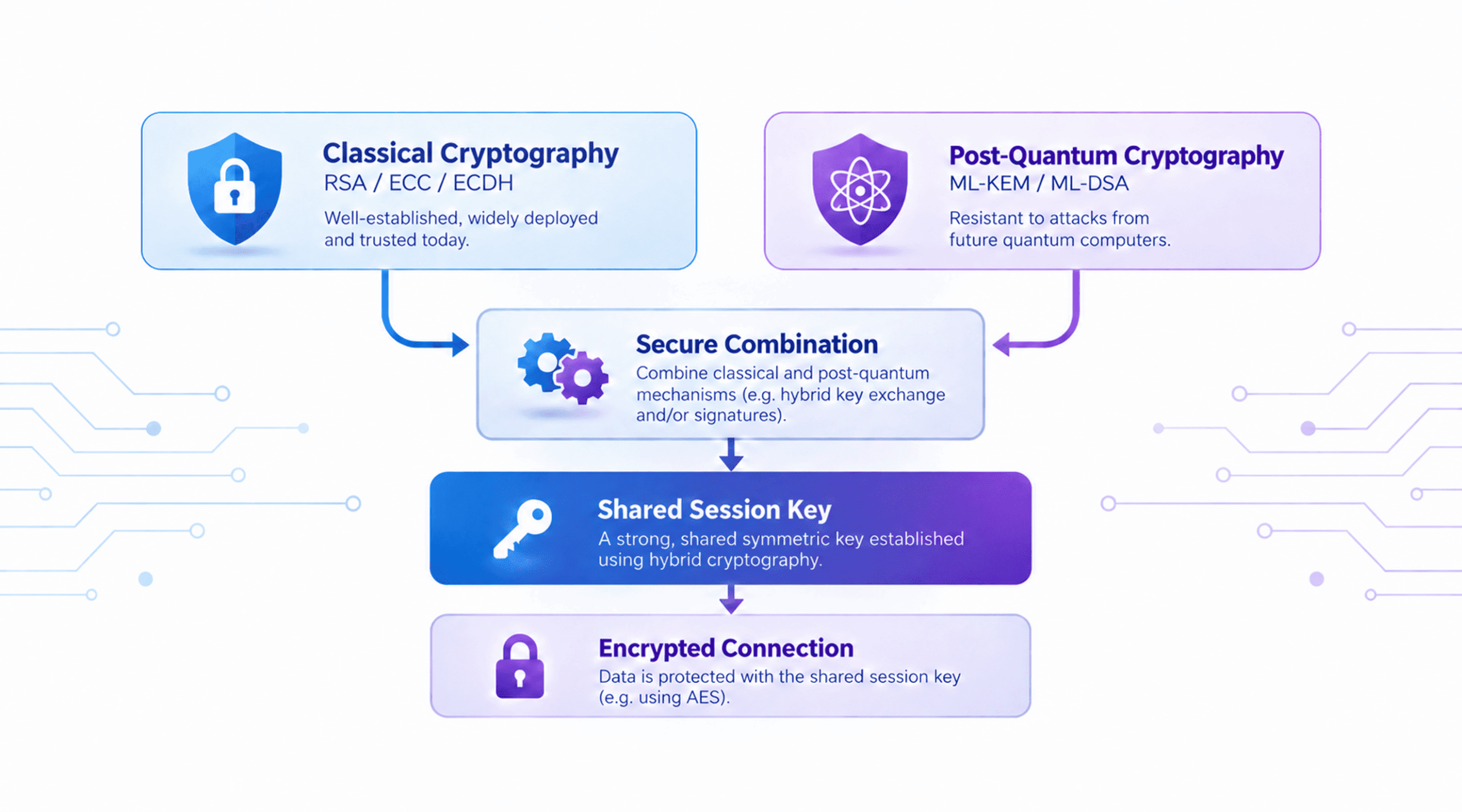
From A Sudden Migration to a Controlled Journey
Hybrid cryptography is best viewed not as the final destination, but as part of a controlled migration strategy.
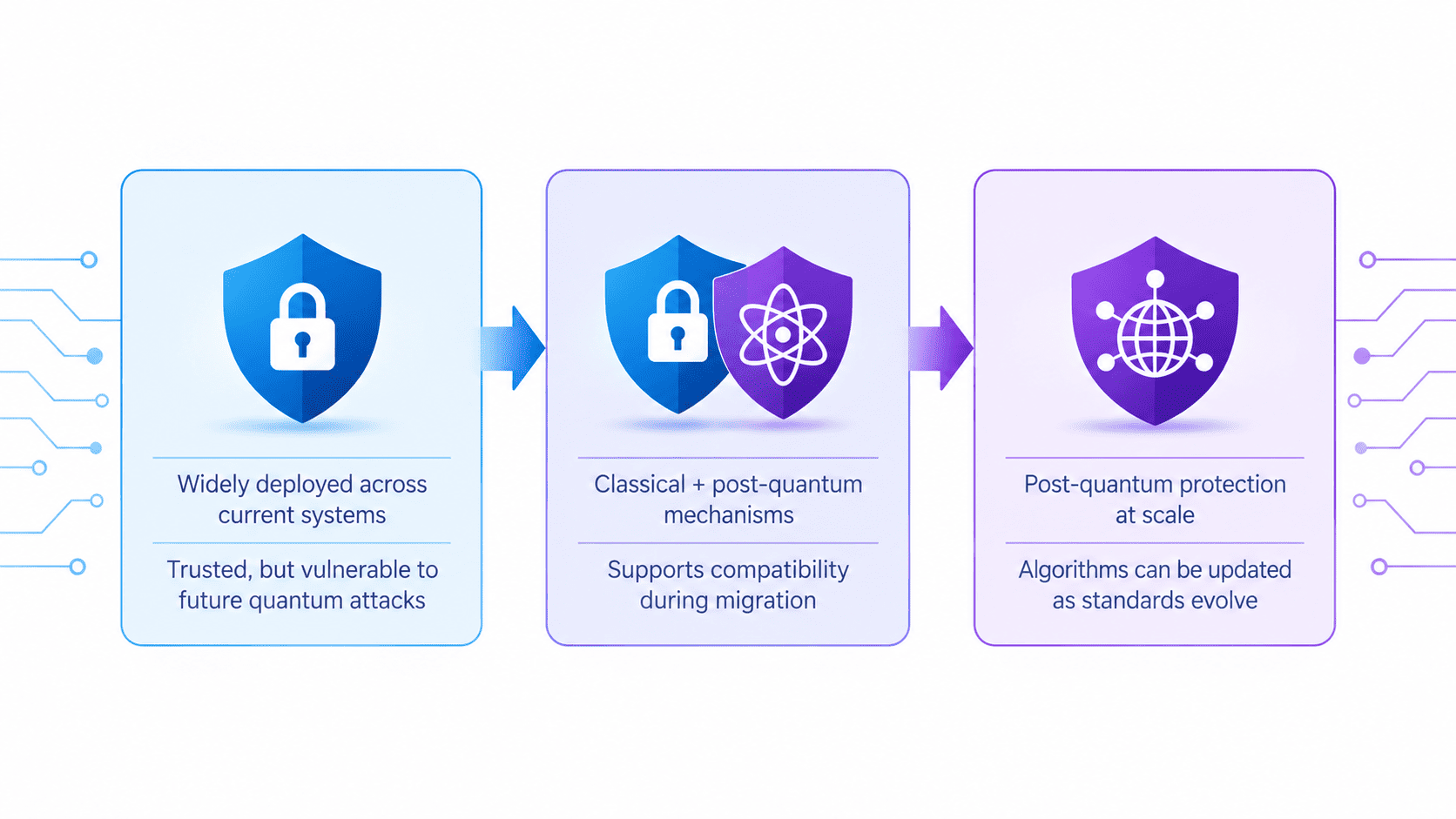
Today, many organisations rely mainly on traditional public key mechanisms. During migration, classical and post-quantum technologies can coexist, with reliance on quantum-resistant mechanisms increasing as implementations and standards mature.
This gradual approach also supports crypto agility. Crypto agility means designing systems so cryptographic algorithms can be changed or replaced without rebuilding the entire application. As standards evolve, that flexibility may become as important as the algorithms themselves.
Hybrid Does Not Mean “twice the security”
Running two cryptographic mechanisms together may sound simple, but the engineering details matter.
The mechanisms must be combined correctly, keys managed securely, and implementations carefully tested, while accounting for processing, message size and compatibility overheads. NIST notes that hybrid approaches can add implementation cost and engineering complexity, so an appropriate security review remains essential.
Hybrid cryptography is therefore not simply a second lock on the same door, but a transition architecture in which established and post-quantum technologies complement each other securely.
Where DOES Q-FENCE Contribute?
Q-FENCE is developing a dual layer cryptographic framework that integrates established technologies with advanced quantum resistant approaches. A key targeted outcome is a secure hybrid transition framework that allows organisations to phase in post-quantum protection while maintaining compatibility with existing systems.
Q-FENCE is validating quantum resistant technologies across finance, healthcare, smart cities, satellite networks and enterprise networks, from constrained platforms to cloud and high speed fibre infrastructure.
These use cases have different performance, confidentiality and deployment constraints, making real world validation essential. Testing them helps determine whether hybrid post-quantum security can move successfully from the laboratory into everyday infrastructure.
Building The Bridge Before We Need It
Post-quantum migration will be a major cryptographic change. The challenge is to manage it securely and practically, using hybrid cryptography to preserve interoperability while quantum resistant technologies are introduced gradually.
Like replacing a bridge while traffic continues to move, the safest transition begins before the old structure reaches its limits. That is the journey Q-FENCE is helping to make possible.